Writing with Agentic AI — Human Words, Machine Design
What if you could just... write?
In writing, a common piece of advice is to write without distraction. That's why so many writing tools are built around the idea of a clean, minimal canvas — and why Markdown has become the go-to for blogging. It's just text. No fiddling with fonts, layouts, or visual design. You focus on the words.
But with agentic AI, this equation changes. What if you could stay in that distraction-free writing flow and get a beautifully designed, interactive page — without switching contexts or learning a design tool?
That's exactly what this post is. Instead of writing Markdown and letting Jekyll render it, I wrote the content — this writeup you're reading now — and asked Claude (via Claude Code) to generate the full HTML page. The layout, the interactive mind map below, the animated GenAI timeline, even the fun toggle controls at the bottom — all generated by AI, while still using my Jekyll-Chirpy theme and CSS.
I wrote. The AI designed. The result is what you see here.
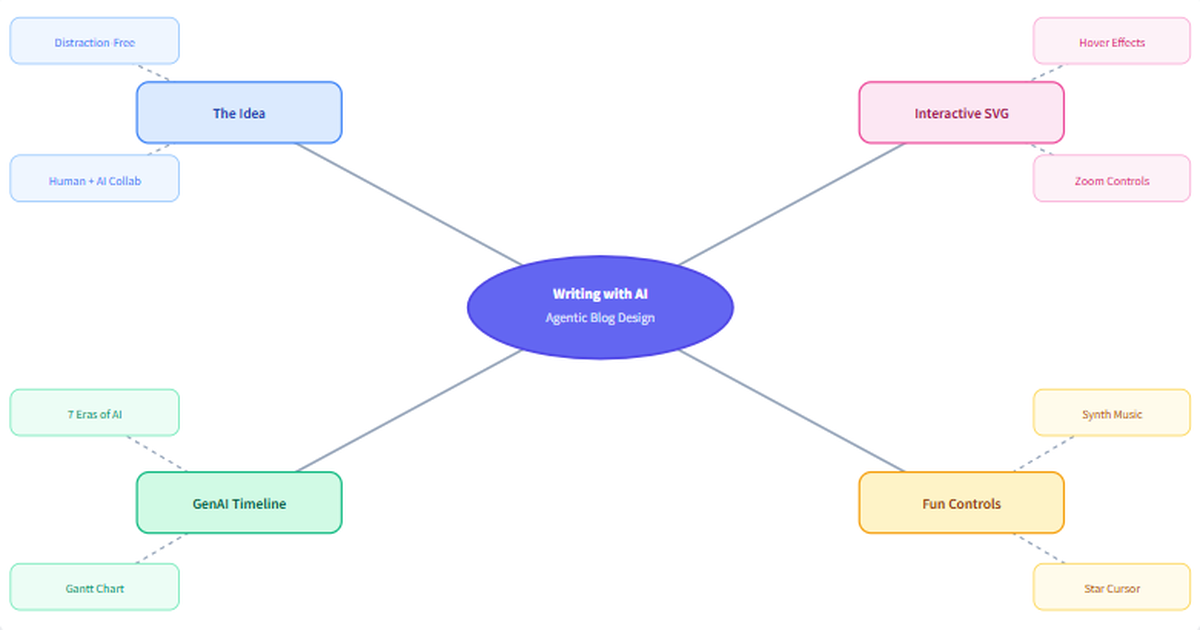
Interactive Mind Map — How This Post Is Structured
Hover over any topic to highlight it and its connections. Use the controls to zoom.
This mind map was generated entirely by Claude Code to give you an overview of this post's four sections: the idea behind distraction-free writing with AI, the interactive SVG mind map itself, a generative AI timeline, and some fun browser-based controls.
The Evolution of Generative AI — An Interactive Timeline
A Gantt chart view of AI's major eras — hover each bar for details
From ELIZA in 1966 to today's agentic AI systems like Claude Code, this timeline traces seven eras of generative AI. Each bar is interactive — hover to see key products and milestones from that era.
LiveBench Rankings — Frontier AI Model Benchmarks
A scrollable slideshow — use the arrows to navigate
This slideshow was built as a reusable Jekyll include — another component Claude Code generated from a single prompt. It contains LiveBench data from January 2026, comparing frontier models across reasoning, coding, and mathematics.
Fun Controls
Because why not
Closing Thoughts
This entire page — the SVG mind map, the interactive Gantt chart, the slideshow with benchmark data, the synth music, and the star trail cursor — was generated by Claude Code while I focused on writing the content you just read. I didn't touch CSS, JavaScript, or SVG. I just described what I wanted, and the AI built it.
This is what agentic AI enables: a separation of concerns between thinking and building. You stay in the creative flow. The agent handles the craft. It's the same principle behind why Markdown became popular for blogging — remove friction so you can focus on what matters. Agentic AI just takes it further.
If you're curious about the tools behind this, I recently wrote about how I structure my AI coding prompts across Claude Code and GitHub Copilot. I also shared a broader framework for thinking about the four ways of AI adoption in organizations. And if you're wondering about the blog platform itself, here's the story of how I moved from WordPress to Jekyll.
The future of writing is not AI replacing writers. It's AI amplifying them. Write freely. Let the machine design.